Plating Electrodes#
The very tips of tetrodes are often plated with a layer of gold, though other coatings can also be used. The goal is to decrease the impedance of the electrode (why?).
The capacitance of a capacitor, in Farads, is proportional to the area of the capacitor plates (A) divided by the distance (d) between them. ε is the electrostatic constant.
To make C bigger, we can increase A by increasing the surface area of the electrode, which is what happens when we gold-plate.
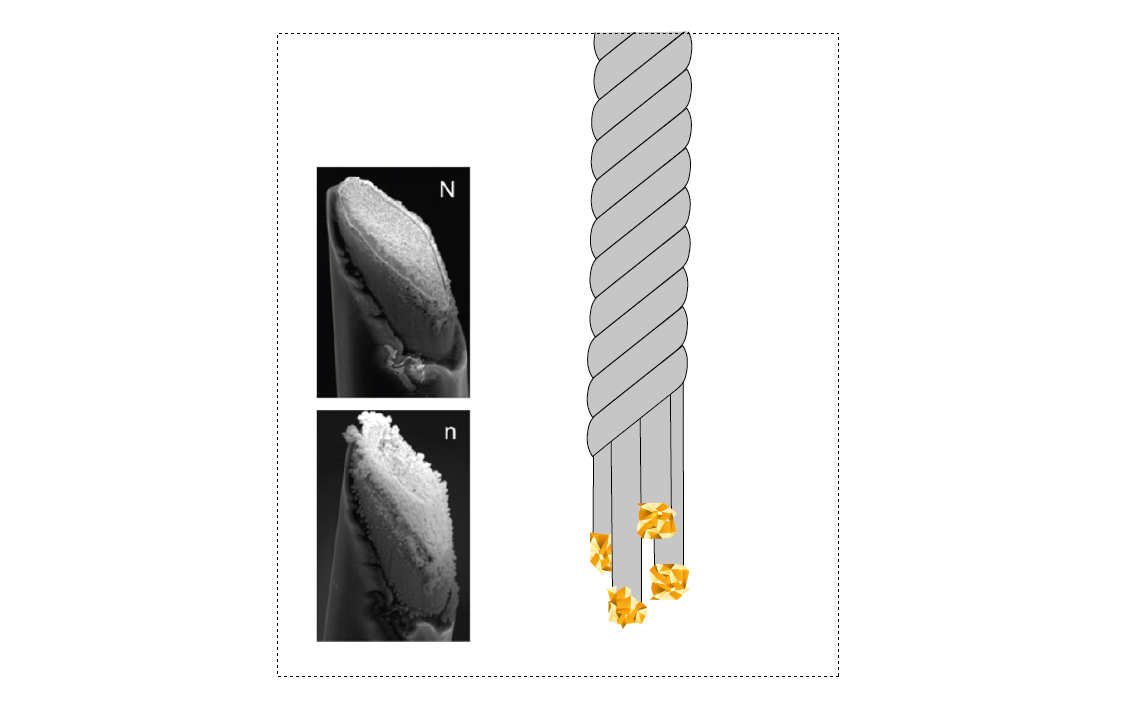
We can also coat electrodes with materials that are already complemented with pseudo-capacitance, such as conducting polymers or transition metal oxide films, e.g IrOx (Green, Lovell, Wallace, & Poole-Warren, 2008; Musa, 2011).
Electrode impedance magnitude is often measured at 1 kHz, before and after electrode coating, showing an impedance decrease up to 10-fold (Neto et al., 2018). By increasing the capacitance (Ce) of our electrode, the electrode impedance (Ze) will be smaller, preserving more of our signal amplitude at Vin (Vin = Vec). Electrodes impedance values are in the kOhm to MOhm range at 1 kHz.